

AI-Ready & Edge-Distributed Infrastructure in APAC — A Strategic Imperative for 2026
Asia-Pacific (APAC) is undergoing a transformative shift away from traditional centralized cloud infrastructure toward distributed, AI-ready, and edge-centric architectures that are driven by the need to serve latency-sensitive workloads such as real-time analytics, autonomous systems, industrial IoT, and next-generation AI applications. This regional progression reflects broader global trends in digital transformation, but the scale, diversity, and regulatory environment of APAC amplify this evolution across multiple fronts.
Asia-Pacific (APAC) is undergoing a transformative shift away from traditional centralized cloud infrastructure toward distributed, AI-ready, and edge-centric architectures that are driven by the need to serve latency-sensitive workloads such as real-time analytics, autonomous systems, industrial IoT, and next-generation AI applications. This regional progression reflects broader global trends in digital transformation, but the scale, diversity, and regulatory environment of APAC amplify this evolution across multiple fronts.
What is edge-centric data infrastructure?
Edge-centric architecture (sometimes called edge-first architecture) is a system design where compute, storage, and data processing happen as close as possible to where data is generated or consumed, instead of relying mainly on a centralized cloud or core data center.
Edge-centric vs hybrid vs cloud-centric
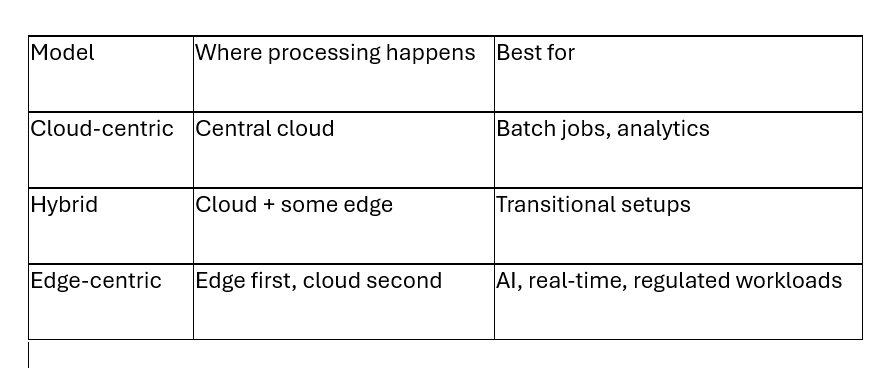
Let’s look at some real-world examples of edge-centric data models to better understand their applications.
Telecom & 5G
Telcos deploy MEC nodes near cell towers.
Enables real-time video analytics, gaming, and smart cities
Manufacturing
Factories run AI vision models locally.
Defect detection in milliseconds
Cloud used for model updates.
Financial services
Fraud detection and transaction scoring at the edge
Reduces response time and risk
Retail
In-store edge servers for personalization and inventory tracking
Works even during network disruptions
Region-Wide Momentum: Edge Growth and Adoption
The APAC edge data center market is projected to grow dramatically from $6.64 billion in 2024 to $36.44 billion by 2034, a robust compound annual growth rate of nearly 18% , highlighting the strategic push for distributed computation closer to end users to reduce latency, improve reliability, and support AI workloads.
An IDC/Akamai study shows that 80% of regional CIOs plan to adopt edge services by 2027, explicitly to support generative AI and other performance-sensitive applications, a clear signal that centralized cloud alone is insufficient for future enterprise needs.
China: Strategic Expansion and Edge-Cloud Integration
China remains a dominant infrastructure force in APAC, both in centralized and edge domains. Its massive 5G rollout — with hundreds of thousands of base stations — and robust industrial IoT landscape support edge computing use cases across smart manufacturing, logistics, and telecom sectors. Enterprises are rapidly adopting edge nodes to minimize latency in applications ranging from autonomous systems to industrial analytics.
According to regional CIO surveys, nearly 37% of Chinese enterprises already run generative AI in production, and 61% are testing, with most relying on public cloud IaaS but concurrently increasing edge investments to address local performance and compliance needs.
India: Fastest-Growing Market and Tier-2 Expansion
India is one of the fastest-growing data infrastructure markets in APAC, surpassing many mature economies in recent capacity growth. The nation’s data center footprint continues to expand rapidly as domestic enterprises and global hyperscalers build both centralized and edge facilities to support burgeoning cloud adoption driven by digital services, e-commerce, fintech, and AI deployments.
Indian enterprises also show high generative AI interest, with 82% in initial testing and a growing percentage deploying AI applications, propelling demand for AI-ready edge infrastructure, especially in Tier-2 and Tier-3 cities, where latency improvement and localized capacity address performance bottlenecks outside metro hubs.
Major technology players, such as Microsoft and Google, have announced significant multi-billion-dollar investments to build out cloud and AI infrastructure in India, underscoring confidence in the market’s long-term growth potential.
Australia: Hyperscale Investments and Cloud Capability
Australia is emerging as a key regional hub for centralized and distributed infrastructure. Large investments — such as **Amazon Web Services’ planned nearly $13 billion expansion in cloud and data center infrastructure through 2029— reflect increased demand for cloud and AI services locally and regionally.
Data center usage patterns also show that a growing share of data (projected to move toward edge or distributed processing) is being driven by the demands of latency-sensitive applications and hybrid architectures.
Singapore & Southeast Asia: Strategic Hubs With Emerging Edge Nodes
Singapore continues to be a critical connectivity and cloud hub in Southeast Asia, traditionally hosting a large share of regional cloud traffic and serving as a landing point for multinational deployments. Singapore’s strategic initiatives — including smart nation frameworks and digital innovation policies — help anchor both cloud and edge expansions.
Neighbouring Malaysia is rapidly expanding its data center ecosystem, with projected capacity surpassing 5 GW by 2035, reflecting how Southeast Asian markets are evolving beyond simple colocation to accommodate AI and real-time workloads — though this rapid growth is drawing scrutiny over sustainability and infrastructure strain.
Regional nations like Thailand are also attracting significant foreign investments — including multi-billion dollar allocations from major cloud providers and hyperscalers — as national policies encourage digital infrastructure build-outs to support cloud and AI service delivery.
Why This Transition Matters?
Latency & Performance: Edge computing brings compute and storage closer to users and devices, reducing round-trip delays, essential for AI inferencing, real-time analytics, and interactive applications.
Regulatory Compliance & Data Sovereignty: Many APAC countries (e.g., India, Indonesia, and Thailand) are imposing more stringent data residency requirements, making localized infrastructure imperative.
AI Workload Distribution: Central cloud architectures struggle with unpredictable latency and throughput spikes from large AI models. Distributed, edge-centric systems help balance loads and deliver compute near data sources.
Industry Scale & Diversity: From manufacturing in China to fintech and e-commerce in Southeast Asia and public sector digitalization across APAC, localized and distributed infrastructure meets diverse and evolving digital demands.
Edge Leaders & Strategic Players
NTT Communications launched new edge computing solutions designed to improve connectivity and cut latency for real-time processing, highlighting its focus on digital infrastructure modernization.
Alibaba Cloud is pushing AI-driven data management platforms and integrated cloud-edge stacks to streamline enterprise data workflows.
Hewlett Packard Enterprise, IBM, Atos, Cisco Systems, Dell Technologies, Arista Networks, Juniper Networks are key infrastructure vendors providing hardware and orchestration layers for hybrid cloud and edge distribution across APAC data centers.
Why It Matters?
The rise of 5G networks in markets such as Singapore, South Korea, Japan, and India fuels demand for distributed computing close to users. Edge data centers can support IoT, autonomous applications, and real-time use cases that centralized clouds struggle with due to latency constraints.
As organizations increasingly adopt Generative AI and analytics workloads, integration between cloud, edge, and on-prem infrastructure becomes a competitive differentiator , positioning service providers and telcos that can handle this hybrid distribution with priority.
Funding APAC Data Infrastructure
Massive investment flows into APAC data infrastructure signal confidence in the region’s growth potential from both global investors and local strategic players.
SoftBank acquired infrastructure investor Digital Bridge for ~$4 billion to accelerate AI and digital infrastructure expansion globally — including APAC-focused projects.
Keppel announced a $10 billion AI-hub development in Victoria (Australia), expanding APAC capacity to over 1 GW and emphasizing renewable power sources.
In India, UPC Volt committed ₹5,000 crore to an AI-ready data center in Telangana, underlining strong local investment interests.
Iron Mountain is evaluating an APAC regional hub and Centre of Excellence in India to foster talent and support cloud and AI infrastructure growth.
Global Players With APAC Stakes
Hyperscalers such as AWS, Azure, Google Cloud, and emerging cloud players like ByteDance’s Volcano Engine are aggressively expanding with AI and GPU infrastructure in China, proving to be pivotal to infrastructure investment trends.
Concluding Summary
As enterprises and cloud service providers compete to deliver high-performance, low-latency, sustainable infrastructure, APAC will increasingly define global standards for data infrastructure modernization.
Reactions